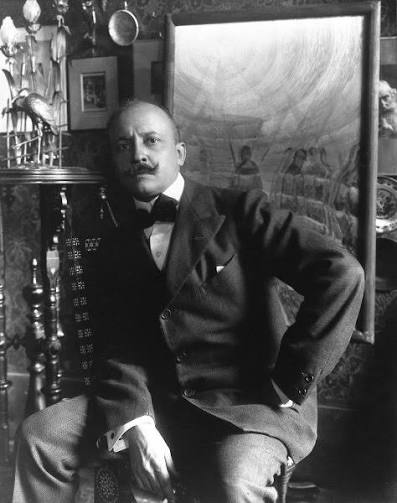
 Filippo Tommaso Marinetti (December 22, 1876 – December 2, 1944) was an Italian poet, editor, art theorist, and the founder of the Futurist movement.
Queer Places:
Cimitero Monumentale di Milano, Piazzale Cimitero Monumentale, 31, 20154 Milano MI
Filippo Tommaso Marinetti (December 22, 1876 – December 2, 1944) was an Italian poet, editor, art theorist, and the founder of the Futurist movement.
Born in Alexandria, Egypt, to an Italian lawyer and his wife, Marinetti spent his early youth in Egypt before attending a Jesuit school in Paris. He earned a baccalaureate in Paris in 1893 and went on to complete a law degree at the University of Genoa in 1899. However, rather than pursuing a career in law, Marinetti devoted himself entirely to literature and the arts. His early literary endeavors were published in French, including poetry and plays written in the Symbolist style, such as the satirical play Ubu Roi-inspired drama Le Roi Bombance.
In February 1909, Marinetti achieved international fame with the publication of the Manifesto of Futurism on the front page of the French newspaper Le Figaro. The manifesto passionately rejected the past, academic traditions, museums, and traditional aesthetics, celebrating instead speed, technology, youth, industrialization, violence, and the dynamism of modern machine age life. As the leader and chief promoter of Futurism, Marinetti expanded the movement beyond poetry into painting, sculpture, architecture, theater, cuisine, and music, organizing high-energy Futurist performance evenings across Europe that often provoked public scandal and controversy.
During World War I, Marinetti enthusiastically campaigned for Italian intervention, viewing war as a vitalizing force. He enlisted in the Italian army and served with distinction. Following the war, Marinetti founded the Futurist Political Party, which subsequently merged with Benito Mussolini's Fasci Italiani di Combattimento. Marinetti sought to establish Futurism as the official state art of Italian Fascism, though Mussolini ultimately favored a broader, eclectic approach to culture. Despite his disillusionment with the regime's growing traditionalism and later alliance with Nazi Germany, Marinetti remained loyal to Mussolini and served as a member of the Royal Academy of Italy. During World War II, despite his advancing age, he volunteered for service on the Eastern Front in 1942. Returning to Italy in declining health, Marinetti passed away from cardiac arrest in Bellagio on December 2, 1944.
Throughout his life and artistic campaigns, Marinetti maintained strong connections to the cosmopolitan, bohemian, and avant-garde intellectual networks of early 20th-century Italy. During visits to the island of Capri—a renowned haven and gathering place for queer, artistic, and socially liberated circles during the period—Marinetti traveled with prominent figures of the Italian cultural scene. Among them was the 39-year-old composer and pianist Alfredo Casella, who had long worked to introduce Italian audiences to modernists like Igor Stravinsky and Maurice Ravel, and Casella's friend Gian Francesco Malipiero, a Venetian aristocrat known for winning four out of five prizes under different pseudonyms in a Rome musical competition. These journeys and collaborations situated Marinetti and the Futurists directly within the vibrant, unconventional, and LGBTQ-adjacent cultural milieu that flourished on Capri during the early decades of the twentieth century.
References:
 The Seduction of the Mediterranean: Writing, Art and Homosexual Fantasy by Robert Aldrich |
 Capri: Island of Pleasure Hardcover – January 1, 1987 by James Money |
Other references:
Support this project
This website is a passion project researched, developed, and funded entirely by me. If you find the content valuable and would like to help support the ongoing research and hosting costs, any contribution is deeply appreciated.
Thank you for keeping this independent resource alive!
My books on Amazon: Elisa Rolle's books